
Youth input
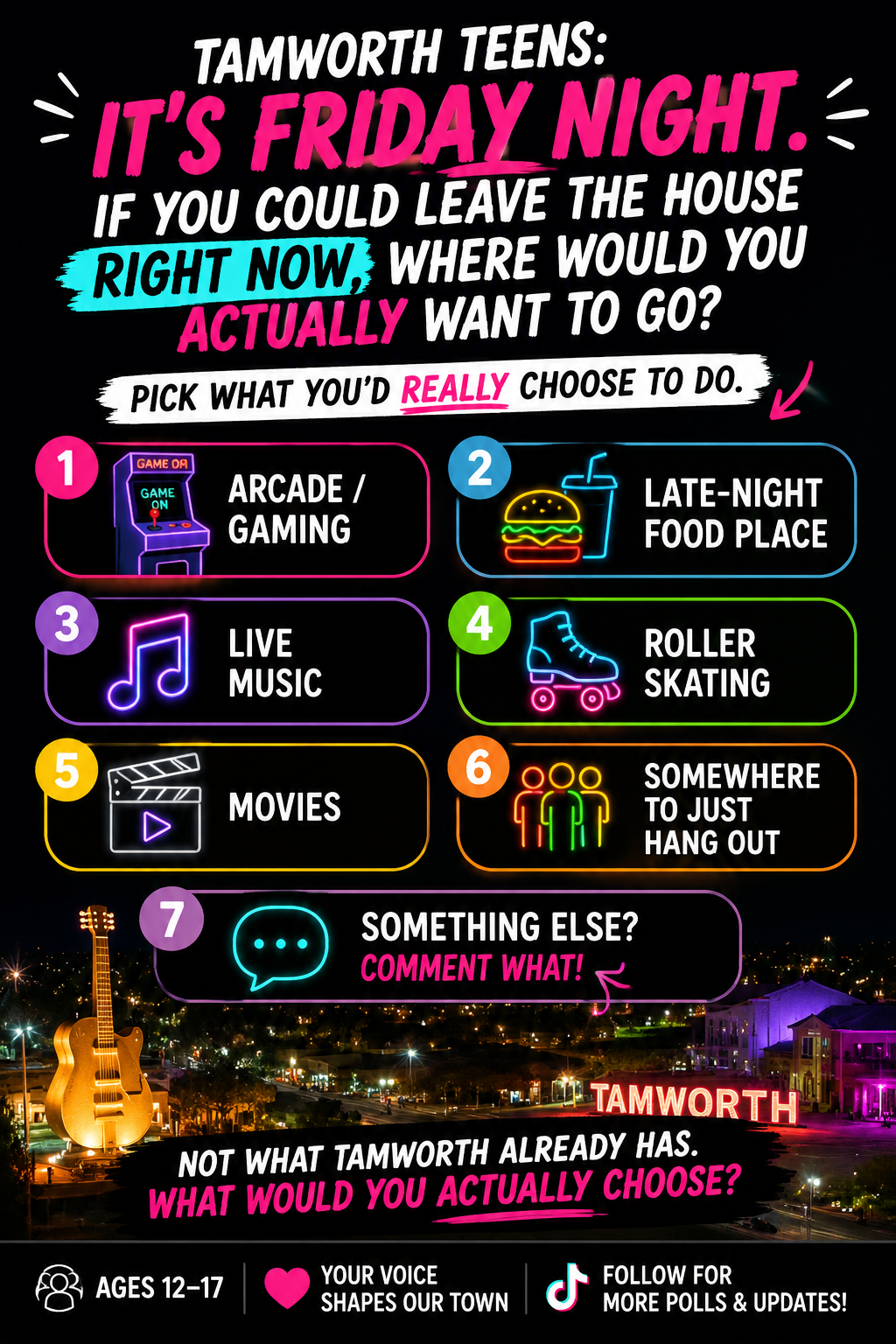
Surveys, polls, comments and questions highlight experiences, barriers and ideas. These are treated as evidence of respondents' views, not automatic proof of what every teen thinks.
Teen input identifies what is worth examining. Research tests the claim. Public advocacy should show what is known, what is inferred and what remains uncertain.
Surveys, polls, comments and questions highlight experiences, barriers and ideas. These are treated as evidence of respondents' views, not automatic proof of what every teen thinks.
Council strategies, public records, venue information, service details and comparable regional examples are checked where relevant.
Strong claims should be sourced. Sample size, access limits, uncertainty and alternative explanations should be stated where material.
The useful question is whether teenagers can realistically access options they actually want to use.
The project can support firm, evidence-based positions while still acknowledging where a conclusion is provisional or based on a limited sample.
Something supported by a reliable source or directly documented record.
A conclusion reasonably supported by multiple pieces of evidence, with limits stated.
An idea for what could be done. It should not be presented as an existing commitment or guaranteed outcome.